
Why Won't My Garage Door Open, and Why Is It Stuck?
A door that refuses to move and a door that jams partway are telling you different things. One quick test with the release cord tells them apart, and from there you will know whether it is a five minute fix or a phone call.
It always seems to happen at the worst time. The car is inside, you are already running late, and you press the button to nothing. Or the motor groans, the door lifts about a hand’s width and stops dead. Or it got halfway up last night and has been hanging there ever since, with the garage open to the street.
We hear all three described as the same problem on the phone. They usually are not. A garage door that won’t open and a garage door that is stuck tend to be telling you different things. The first points at power, the opener or a spring. The second points at something physically binding, such as a cable, a roller, a track or a lock. Once you know which one you have, you are most of the way to knowing what the repair involves, and whether you can sort it out yourself before your coffee goes cold.
This is written from the jobs our technicians attend every week across Perth. It covers automatic and manual garage doors, roller doors and sectional doors, and it is plain about where the safe checks end.
Start with the release cord test
Do this before anything else. It sorts nearly every “won’t open” or “stuck” call into one of three groups, and it takes about thirty seconds.
- Check the door is fully closed. If it is stuck part-open, skip the test and read the stuck door section first.
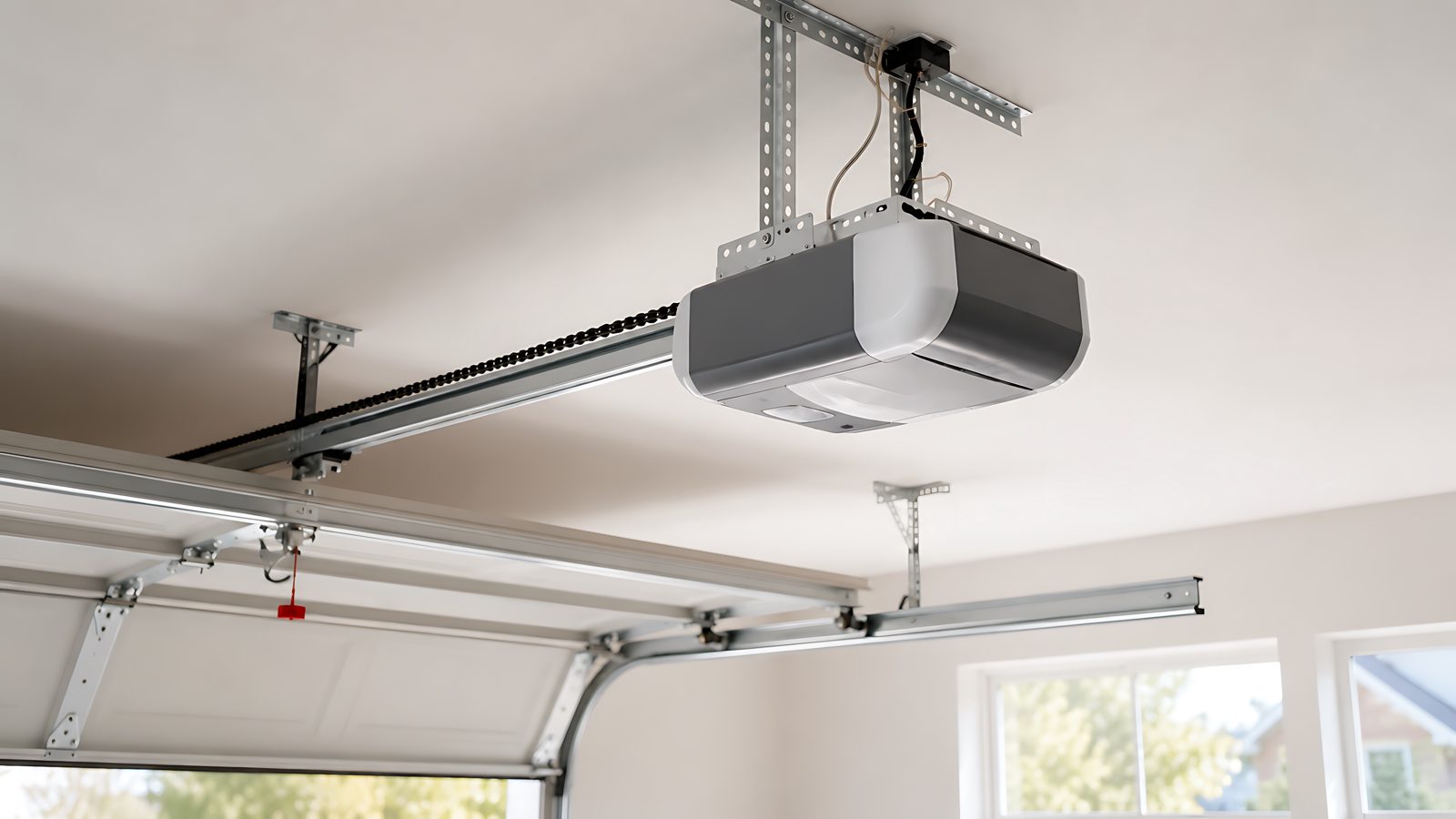
- Find the red handle hanging from the opener rail. Pull it down and back toward the motor to disconnect the door.
- Take hold of the bottom of the door with both hands and lift gently.
How the door responds tells you where the fault lives.
- It lifts smoothly, feels light and stays put at waist height. The door is healthy. A balanced door of any size needs only about 5 to 10 kilograms of effort. Your problem is on the automatic side: power, remotes, the wall button or the opener itself.
- It will not budge, or it feels like dead weight. The counterbalance has failed. That means a spring or a cable, and it means you lower the door gently and leave it alone.
- It moves, but scrapes, catches at one spot, or one side rises ahead of the other. That is a stuck door rather than a dead one. Think rollers, tracks, cables or a lock.
To reconnect afterwards, pull the cord toward the door and run the opener once. Most units latch back on by themselves.
One firm rule. Never pull the release on a door that is sitting open unless someone is holding it. If the springs have failed, the opener is the only thing keeping that door up, and disconnecting it drops the full weight of the door in an instant.
Why won’t my garage door open?
These are roughly in the order we find them, which happens to be cheapest first.
Nothing at all: no light, no click, no hum
Check the power before you blame the opener. Openers run from a ceiling power point that is easy to switch off by accident, and a wet winter storm will happily trip the RCD at the switchboard. Plug a lamp or a phone charger into that power point. If it is dead, go to the switchboard. If it is live and the opener is still dark, the fault is inside the unit, usually a blown fuse on the board, a failed transformer or a perished lead.
After a blackout, some openers come back with their travel settings scrambled or their remotes forgotten. If the power is still out and you have no battery backup, the release cord is your way out. There is more on this in our garage door won’t open guide.
The light is on, but the remote does nothing
Try the wall button. If the wall button opens the door and the remote does not, the opener is fine and the remote is the problem. Most of the time that is a flat battery, usually a CR2032 coin cell that costs a few dollars at the supermarket. Lost pairing after a power surge comes next, then radio interference. Cheap LED downlights are notorious for drowning out the 433 MHz signal most Australian openers use. Our remote troubleshooting article walks through reprogramming by brand, and if a new battery does not help, garage door remote repair is one of the quickest jobs we do.
If it is the other way around and the remote works while the wall button does not, look at the thin two-core wire running from the console to the opener. It gets crushed by staples, chewed by rodents and pinched by shelving. Here is how to narrow that down.
If neither works but the opener light comes on, look for a small padlock symbol on the wall console. Lock or holiday mode shuts the remotes out completely, and it is easy to press with a shoulder while carrying the shopping in. Hold the button for a few seconds to release it.
The motor runs, but the door stays where it is
If you can hear the opener working, look up at the trolley on the rail. If it travels along the rail while the door sits still, the trolley has been disconnected, nearly always because someone pulled the release cord during the last blackout and never reconnected it. Pull the cord toward the door and run the opener to re-latch it.
If the trolley does not move at all and the motor just whirs, the nylon drive gear inside the opener has probably stripped. You will often find fine white plastic dust on the floor directly under the motor. It is a common failure on Merlin and Steel-Line openers, and it is a repair, not a reason to buy a new unit. The real question is why it stripped, and the answer is usually a door that has grown heavy on tired springs. We go through it in detail on the motor runs but door doesn’t move page.
A motor that hums without turning, especially one that works at seven in the morning and refuses at four in the afternoon, points at the start capacitor. Perth summers are hard on them. Whether to fix or replace an older opener comes down to its age and which part failed, and this article sets out where that line sits.
The door lifts a few centimetres, then gives up
This is the textbook broken spring. The opener lifts the door about 15 centimetres, feels the full weight of it, hits its force limit and stops. Very often someone heard a loud bang from the garage earlier, sometimes days earlier when nobody was using the door. Look, without touching, at the spring on the shaft above the opening. A snapped torsion spring shows a clean gap of about 50 millimetres in the coil.
Springs are the one thing in this article that is never a DIY job. A garage door opener is built to guide a balanced door, not to lift one, so the springs do almost all the work, and a wound spring stores enough energy to break bones. Here is how to tell for certain that a spring has gone, and what garage door spring repair involves. We replace them in pairs, because the one that has not snapped yet is the same age and has done the same number of cycles.
If instead the door rises most of the way and stops at the same height every time, the upper travel limit may be set short, or the door may be getting harder to lift than the opener expects. That pattern has its own page.
The door is still locked
Plenty of Perth garages still have a slide bolt or a lock bar left over from before the opener was fitted. If one has been thrown into the track, or the centre handle on a roller door has been turned, the opener pulls against a locked door, stalls, and looks for all the world like it has died. Slide the bolts back and try again.
If the handle on a roller door spins freely without doing anything, the lock cable inside has snapped and one latch is probably still hooked into the side guide. That door will stay jammed until the lock is sorted. Our garage door lock repair page covers what goes wrong inside.
Why is my garage door stuck?
A stuck door has a different story. It started moving and something stopped it, or it is jammed and will not go either way. Where it stopped is the best clue you have. If your garage door is stuck closed, the causes overlap almost completely with the section above, so start there.
Stuck halfway, or hanging part-open
There are two possibilities. Either the opener cut out mid-travel because of a power drop, the safety reversal or the force limit, or the door has jammed mechanically. If the door is sitting level and the opener light is flashing, try the wall button once. If the door is crooked, groaning, or the motor runs without moving it, stop pressing.
Do not walk or drive under a part-open door, and do not prop it up with timber or a car jack. If the house is exposed overnight, that is exactly what emergency garage door repair is for. There are more safe checks on the garage door stuck half open page.
Stuck crooked, with one side higher than the other
This is almost always a lift cable that has snapped or come off its drum. With one side no longer carrying its share, the door racks sideways in the opening and binds hard against the tracks. Every press of the button twists the panels a little further, which is how a cable job turns into a garage door panel replacement. See crooked or jammed doors for what to look for, and garage door cable repair for how it gets fixed. Cables, like springs, are under tension and should be left to a technician.
Stuck at the same point every time
A door that shudders and stops at the same height on every run has a track or roller problem. Common culprits are a track dented by a car bumper or a bike handlebar, a roller with a collapsed bearing, or a track bracket that has worked loose. On roller doors, look into the side guides for packed grit, leaves, spider nests or a lip bent inward near the bottom. Perth’s fine limestone dust mixes with old grease into something close to grinding paste, which is why we use a dry silicone lubricant rather than a wet oil. Garage door track and roller repair usually takes about an hour.
If a roller has come right out of the track, stop using the opener entirely. Running the motor against a derailed door is the fastest way to bend the track and crease a panel. Read garage door off its track before touching anything, and see what off track repair involves.
Stuck open and refusing to come down
That is a different family of faults, almost always the photo eye safety beams near the floor. It has its own troubleshooting article.
Automatic and manual garage doors get stuck for different reasons
Automatic garage doors
An opener adds power, electronics, remotes, safety beams and stored travel limits, and any one of them can stop a perfectly good door. When an automatic garage door won’t open, a fair share of the time the door is mechanically fine. The opener has simply decided not to move it.
The less obvious problem is that an opener hides a failing door. Springs lose tension slowly over years, and because the motor quietly takes up the slack, nobody notices the door getting heavier. The first sign is often the drive gear stripping or the door stopping halfway one morning. That is why the balance test matters more on an automatic door than on any other. Pull the release, lift the door to waist height and let go. If it drops or climbs on its own, the springs need attention before the opener pays for it.
We carry drive gears, capacitors, remotes and safety eyes for the common brands, including B&D, so most automatic garage door repairs are finished in one visit.
Manual garage doors
On a manual garage door you are the motor, which has one real advantage: you can feel trouble coming. A door that took one hand last year and needs two this year has springs that are losing tension. If you have a manual garage door that is getting too heavy to lift, have it balanced before a spring lets go.
A manual garage door that is stuck usually comes down to one of a handful of things. Tired springs, a seized lock or a snapped lock cable, dry or dented guides, and on roller doors a creased curtain that no longer rolls cleanly onto its drum. Many older manual roller doors and tilt doors in established suburbs like Como, Manning and Bayswater have done decades of service and show all of it. Roller door repair and sectional door repair cover the two main types, and this comparison explains what typically breaks on each.
If you are thinking about fitting an opener to a manual door that has become hard work, have the door balanced first. An opener fitted to a heavy door wears out its drive gear long before it should.
What you can safely check, and where to stop
Safe to do yourself:
- Check the ceiling power point and the RCD at the switchboard
- Replace the remote battery and check the lock button on the wall console
- Re-latch the opener trolley
- Slide back any bolts and check the centre handle
- Sweep the threshold, clear debris from the tracks and wipe the sensor lenses with a dry cloth
Stop and phone if:
- you can see a gap in a spring, or a cable is slack, frayed or off its drum
- the door is hanging crooked
- it feels heavy by hand or drops when you let go
- a roller has left the track
- the door is stuck part-open and you cannot safely close it
Springs, cables, drums and bottom brackets hold enough stored energy to cause serious injury, and they release it without warning. And stop pressing the button. Each extra attempt strips a few more gear teeth, twists the panels a little further or pulls a roller further out of line. Our family safety checks are worth ten minutes once the door is working again.
Most stuck garage doors gave a warning first
Very few garage doors fail out of nowhere. When we ask, most people remember something: a new squeal or grinding noise, slower travel, a jerk at the same point each time, the door needing a second press, or a cable that had started to look hairy.
Perth conditions speed all of this up. Fine limestone dust packs into tracks, especially in newer estates like Ellenbrook. Salt air corrodes springs and hinges in coastal suburbs such as Scarborough and Fremantle. Summer heat cooks opener capacitors and cracks seals, and storm season brings the blackouts that scramble opener limits.
Regular garage door maintenance catches most of it early. A service takes about an hour and covers balance, spring tension and remaining cycle life, cables, rollers, track alignment, opener force settings and the safety reversal. A typical spring is rated for around 10,000 cycles, which is roughly seven years at four uses a day, so a door that has never been looked at is often closer to failing than it seems. If you would rather do the basics yourself, our quarterly maintenance checklist takes twenty minutes and needs nothing more than a socket set and the right spray.
What the repair will cost
We do not publish a price list, because a stuck door can be anything from a tripped switch to a pair of springs and two cables, and the right spring depends on the weight of your door. What we do is look at it, tell you what has failed, and give you one fixed price before any work starts. There is no call-out fee, so finding out costs nothing. Our pricing page explains how we quote, and this article on repair costs covers what pushes the figure up or down.
Quick answers
Why won’t my garage door open with the remote when the wall button works?
The fault is in the remote, its pairing, or radio interference. Change the battery first, then try reprogramming. If a second remote fails as well, the receiver in the opener is the likelier culprit.
Why won’t my garage door open after a power outage?
Check that the RCD has not tripped, and that the trolley was reconnected if anyone used the release cord during the outage. Some openers also lose their travel limits or remote codes when the power drops and need them set again.
Why is my garage door stuck and won’t go up or down?
A door that will not move in either direction is usually held by a cable jammed on its drum, a roller out of its track, or a lock that is still engaged. Check the lock, then leave the rest. Forcing a jammed door bends tracks and creases panels.
Can I open a stuck garage door by hand?
Only if it is fully closed and lifts easily once the release cord is pulled. If it is heavy, crooked or part-open, do not try to force it.
How long does a garage door repair take?
Most repairs take between 45 and 90 minutes on site. We carry springs, cables, rollers, remotes and common opener parts on the van, so the majority are finished in a single visit.
Get your garage door moving again today
We are based in Morley and offer same day garage door repair right across Perth, so check the areas we cover. When you phone, three things help us turn up with the right parts: what kind of door it is (roller, sectional or tilt, automatic or manual), what happens when you press the button, and what the door did when you pulled the release cord. That is usually enough to know before we leave whether we are dealing with a spring, a cable or the opener.
No call-out fee, a fixed price before we start, and if it sounds like a tripped switch on the phone, we will say so before anyone gets in the van. If your car is trapped or the door is stuck open overnight, treat it as an emergency garage door call and phone straight away.
Rather someone just fixed it?
We repair garage doors across Perth the same day you phone, with no call-out fee and a fixed price agreed before any work starts.
Want this priced for your door?
Send us the details and we will come back to you with a price. No call-out fee either way.