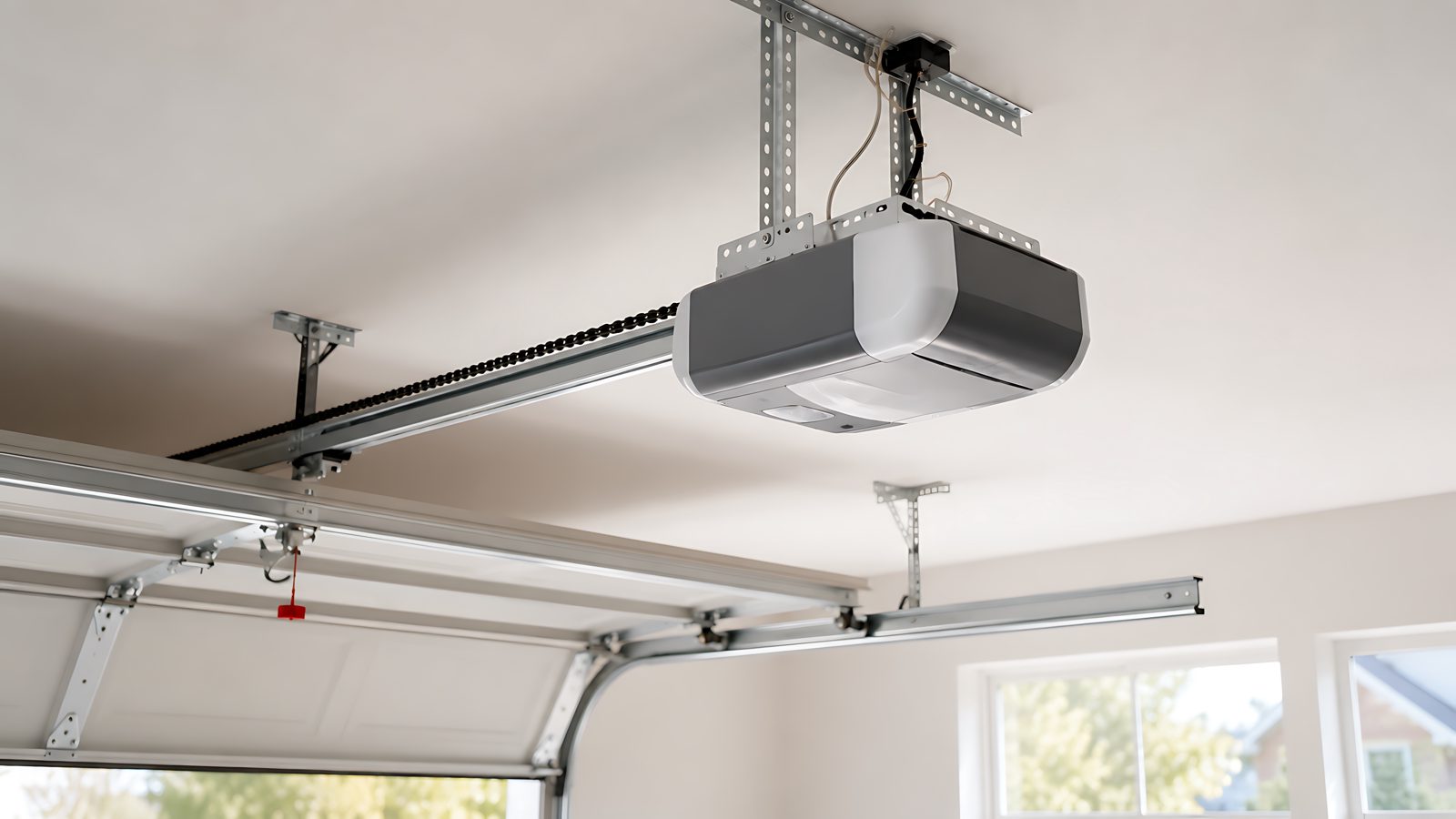
Garage Door Motor Replacement: How to Choose the Right Motor
Replacing a garage door motor starts with the door, not the box on the ceiling. How to choose the right motor for your door, what matters in Perth, and how we take care of every step for you.
Sooner or later every garage door motor reaches the point where another repair stops making sense. The gear has already been replaced once, the logic board is no longer made, or the windings burnt out on a 40 degree afternoon. In estates like Ellenbrook and Joondalup, where whole streets were fitted with openers in the same year, motors tend to reach that point in waves. Deciding whether yours is there yet is its own question. This article starts where that one ends: you need a new motor, so which one?
Browse any supplier and it looks like a choice between brands and price points. In practice your door has already made most of the decision. The type of door sets the kind of opener, its size and weight set how strong the motor needs to be, and where the garage sits in the house decides how quiet it should be. Get those right and the brand matters far less than the sales pitch suggests. Get them wrong and a brand new motor can be labouring, or stripping its gear, within a couple of years.
The good news is that you do not have to work through any of this alone. Everything below is what we check and decide on every garage door motor replacement we do. Read it to understand the choices, then get in touch and we will make them with you, or simply take care of them for you. Advice costs nothing, even if you are only weighing things up.
The short version
If you only read one part of this article, make it this one.
- Match the opener to the door. Roller doors take a roller door opener that mounts on the drum. Sectional and tilt doors take a ceiling-mounted opener on a rail, or a wall-mounted unit where the ceiling is crowded.
- Size it to the door with room to spare, never to make up for tired springs.
- Choose belt drive if the garage is under or beside a bedroom. Chain drive suits a detached garage or a very heavy door.
- Get battery backup in Perth, especially if the garage is how you get into the house.
- Pick a brand with parts and remotes in Perth, so the next repair is a gear kit rather than another new motor.
- Have the door checked and balanced first. A new motor on a badly balanced door wears out early.
We handle every one of these on the job. If you would like a second opinion on any of them, send us a message and ask.
Start with the door, not the motor
This is the step most people skip, and it is the one that decides whether a new motor lasts.
A garage door opener is not built to lift a door. The springs do that by carrying almost the whole weight of the door, so the motor only has to guide a balanced door up and down. When the springs have lost tension, the rollers have flat spots or a track has been knocked out of line, the motor ends up doing work it was never designed for. It pulls harder, runs hotter and wears its drive gear down a little more every cycle. A door that rumbles or scrapes on its way up is often telling you this already, and a grinding noise is worth tracking down before any new motor goes on.
A new motor does not fix that door. It just starts its life the same way the old one ended. Worse, the force setting has to be turned up to push through the resistance, which makes the safety reverse slower to react to a person or a car in the way.
You can get a rough idea yourself with the balance test from our family safety checklist. With the door closed, pull the emergency release cord, lift the door by hand to about waist height and let go. A balanced door stays roughly where you leave it. If it drops, or it is too heavy to lift by hand, the springs have lost tension, and that needs sorting before any motor goes on.
It also pays to ask why the old motor failed. A drive gear that stripped after five years on a door that feels like a tonne by hand is a door problem, not a motor problem, and a new motor will meet the same end.
We do this part for you. Every motor replacement we do starts with a proper look at the door. If it needs spring repair, new cables or tracks and rollers, or it has come off its track, we tell you before anything is ordered and can usually sort it on the same visit. If the door has gone years without attention, a service and maintenance visit covers the lot, and our Perth maintenance checklist shows what you can keep on top of between visits.
Which type of opener your door needs
| Your door | Opener it takes | Where it mounts |
|---|---|---|
| Roller door | Roller door opener | On the drum, at one end of the curtain |
| Sectional (panel-lift) door | Ceiling-mounted opener on a chain or belt rail | On the ceiling, centred above the door |
| Sectional door with a crowded ceiling | Wall-mounted opener | Beside the door, on the end of the spring shaft |
| Tilt door | Ceiling-mounted opener with a tilt door arm | On the ceiling, centred above the door |
Roller doors. A roller door opener is a compact unit that bolts to the drum wheel and turns the drum directly, so there is no rail across the ceiling. It needs a little clear space beside the drum at the motor end. The spring inside the drum still does the lifting, so its tension has to be right before the motor is fitted. That is part of any roller door repair we do, and if you are not sure which door you have, our roller and sectional comparison shows how to tell at a glance.
Sectional doors. These take a ceiling-mounted opener. The motor head sits back from the door, with a rail running to the top of the door and a trolley that pushes and pulls it. Two measurements matter. Headroom, the gap between the top of the door’s travel and the ceiling, has to fit the rail and the trolley. Rail length is set by the door height, so a taller door, such as a caravan or boat bay, needs a longer rail or an extension kit. The panels, hinges and rollers all have to be in good order too, which is where sectional door repair comes in.
If the ceiling is crowded with ducted air conditioning, storage racks or a beam, a wall-mounted opener can be the answer. It sits beside the door and drives the spring shaft directly, which leaves the ceiling clear. It only suits sectional doors with torsion springs on a shaft above the opening, and it costs more, but in the right garage it solves a real problem.
Tilt doors. A one-piece tilt door takes a ceiling-mounted opener fitted with a tilt door arm. These doors are heavy and swing out over the driveway as they open, so the spring setup and the safety settings matter even more than usual.
Not sure which you have? Send a photo of the door and the motor through our quote form and we will tell you which opener it takes, and whether the headroom and power point suit it.
How strong the motor needs to be
Openers for sectional and tilt doors are rated by how hard they can push and pull, given in newtons. Roller door openers are rated by the size of curtain they can handle, usually as a maximum door area in square metres. The figure you need comes from the door itself:
- Width. A standard single door is around 2.4 metres wide and a double around 4.8 metres. In estates like Canning Vale, 4.8 to 5.0 metre doubles are close to universal, and newer homes go wider again.
- Height. Caravan, boat and four-wheel drive bays are taller, which means more door to move.
- Material. Insulated panels, timber and timber-look cladding, composite finishes and glazed panels all add weight. The timber-clad doors common in the hills around Kalamunda are some of the heaviest we see.
- Wind rating. Wind-locked roller doors sit tighter in their guides, so check that the opener is rated for them.
Choose a motor rated comfortably above what the door needs rather than right at its limit. A motor working at the edge of its rating runs hot, and a Perth garage on a January afternoon is already hard on electronics and plastic drive gears.
Think about how often the door runs as well. A household that uses the garage as its front door, with three or four drivers coming and going all day, puts more cycles on an opener in one year than a quiet household does in three. A unit built for heavier use is worth it there. Shared doors in apartment and unit complexes work harder again, and our commercial garage door repair page covers those.
The one upsell to turn down. A bigger motor is never the fix for a door that feels heavy. It will move the door, but only by overpowering a fault that is still there, with the force turned up and the safety reverse dulled. If someone suggests a stronger motor for a heavy door without mentioning the springs, ask why.
We size it for you. We work out what your door needs from its size, its weight and how often it runs, then recommend a motor with the right margin. You never need to read a newton rating to get this right.
Chain drive or belt drive
This choice only applies to ceiling-mounted openers on sectional and tilt doors. Roller door openers drive the drum directly.
| Chain drive | Belt drive | |
|---|---|---|
| Noise | A noticeable metallic rattle | Quiet and smooth |
| Strength | Very tough, copes well with heavy doors | Strong enough for nearly every home |
| Upkeep | A tension check and a light lubricant now and then | Very little |
| Near the coast | Rusts if it is neglected | Holds up better in salt air |
| Best for | Detached garages, sheds, very heavy doors | Garages under or beside bedrooms |
If anyone sleeps above or next to the garage, belt drive is the easy decision. The sound of a chain travels through the frame of the house, and an early start before work reaches everyone. In a detached garage or a workshop at the end of a long driveway, nobody hears it, and a chain’s toughness is worth more than the quiet.
Close to the ocean, in suburbs like Scarborough, Cottesloe and Fremantle, salt air works on bare steel. A chain will rust and stiffen unless it is kept clean and lightly oiled, which tips the decision further toward a belt.
Ask us before you choose. Tell us where the garage sits and who sleeps nearby, and we will tell you which drive makes sense for your house. It only takes a minute to answer.
Features worth paying for in Perth
Every opener on sale today has rolling-code remotes and an automatic safety reverse. Beyond that, these are the extras that earn their place:
- Battery backup. Summer storms on the coastal plain and winter storms in the hills cut the power every year. Without backup, the door stays shut until the power returns or someone pulls the release cord from inside, and if the garage is your only way into the house, you are locked out. Backup batteries last a few years and then need replacing like any other battery.
- Safety beams. A pair of infrared sensors near the floor that stop the door closing on a child, a pet or the back of a car. We recommend them on every install, and they are essential if you want auto-close. If a door already has beams and keeps closing and then reopening, sensor repair is usually a quick job.
- An outside emergency release. If the garage has no other door, a key-operated release on the outside lets you in during a blackout, even when the backup battery is flat.
- Soft start and soft stop. Most modern DC motors ease into each movement and slow down at each end. That is quieter, and gentler on the door, the rollers and the drive.
- Phone control. Handy for letting someone in, or checking from work that you closed the door. It needs a usable wi-fi signal in the garage, and brick and steel garages are often dead spots, so check your phone’s signal standing next to the motor first. Some brands build it in, such as myQ on Merlin and Chamberlain openers, while others use an add-on module.
- Auto-close. Useful for anyone who forgets, but only with safety beams fitted and working. Our article on doors that will not close explains how the beams decide when a door is allowed to shut.
If you are replacing an opener old enough to use fixed-code remotes, the new one is a genuine security upgrade on its own. A remote with a row of tiny switches inside is one of those, and our remote guide explains why that matters.
We set all of this up. Whichever features you choose, we fit them, set them up and test them before we leave. We will also tell you honestly which ones are worth paying for at your house and which ones you can happily skip.
Brands, parts and remotes
There is no single best garage door motor brand. The ones we see most across Perth are B&D, Merlin, Steel-Line, Gliderol, ATA and Centurion, along with Dominator, Boss, Guardian, Danmar and Secura Lift. Each of them makes good units, and we work on all of them. The full list is on our brands page.
What matters more than the badge is what happens in eight years when the motor needs a gear or a board. A brand with parts and remotes on the shelf in Perth turns that into a small repair. A cheap import with no local support can turn it into another new motor.
Remotes are the cost people forget. Each brand uses its own coding system, such as Security+ 2.0 on Merlin, TrioCode on ATA and Tri-Tran on B&D, so moving to a different brand almost always means new remotes, plus a new keypad if you have one. Count how many remotes the household uses and make sure the price includes all of them. If your current remotes are the real problem rather than the motor, check the remote first, because remote repair costs far less than a new opener.
Lastly, compare warranties on what they cover and for how long, not just the headline number of years.
We handle the remotes too. We count them with you, include every one in the price and code them all on the day, along with any keypad.
Power and placement
A ceiling-mounted opener needs a power point close to where the motor head will sit. Older installs sometimes run off an extension lead from a wall socket, which is not a good long-term setup. If a new power point is needed, that is work for a licensed electrician, and we will tell you when we look at the door so it does not hold up the day.
The wall button should be within sight of the door, so whoever presses it can see the doorway is clear, and high enough that small children cannot reach it. If the old button has been playing up, here is how to tell whether it is the button or the wiring, and we check both when the new motor goes in.
What changes the price
We do not publish a set price for motor replacement, for the same reason we do not publish one for springs: too much of the job depends on the door in front of us. These are what move the figure:
- Roller door opener or ceiling-mounted opener, and chain or belt drive
- The size and weight of the door, which sets how strong the motor needs to be
- Extras such as battery backup, phone control and safety beams
- How many remotes and keypads you need
- A longer rail for a tall door
- Anything the door needs first, such as springs, rollers or cables
- Access, such as a high ceiling or a crowded garage
You get one fixed price that covers all of it before anything is ordered or fitted. There is no call-out fee, so finding out costs you nothing. Our pricing page explains how we price work, and what garage door repairs cost in Perth goes through the other jobs that sometimes come up alongside a new motor. When you are ready for a figure, ask for a quote.
We take care of all of it
You do not need to work any of this out yourself. When you book a garage door motor replacement with us, we:
- Check the door first. Type, size, weight, springs, rollers and tracks, plus a balance test, so the new motor goes onto a door that is ready for it.
- Measure the garage. Headroom, side room, rail length and where the power point is.
- Recommend the right motor. One that suits your door and the way your household uses it, from a brand with parts and remotes available in Perth, and we explain why.
- Give you one fixed price for the motor, the remotes and anything the door needs, before anything is ordered.
- Fit it and set it up properly. Travel limits and force set to suit your door, the safety reverse tested against a solid object, and every remote and keypad coded. If the opener has phone control, we connect it to your wi-fi and the app.
- Show you the emergency release, so everyone in the house knows how to open the door during a blackout.
We are not a dealer for any manufacturer, so the recommendation comes from your door, not from a sales target. And if your current motor only needs a gear kit or a capacitor, we will tell you that before we sell you a new one. Those repairs are covered on our motor and opener repair page. You can read more about who we are and how we work, or browse every service we offer.
Questions before you decide? That is what we are here for. Whether you want to know which motor suits your door, whether your current one is worth saving, or what a fair price looks like, get in touch and ask. There is no obligation, and no question is too small.
Questions about garage door motor replacement
What garage door motor do I need?
Start with the door type. Roller doors need a roller door opener, while sectional and tilt doors need a ceiling-mounted or wall-mounted opener. From there it comes down to the size and weight of the door, how quiet it needs to be, and whether you want battery backup. If you send us a photo of the door and the label on your current motor, we can usually narrow it down before we visit.
Can you help me choose, even if I am not ready to book?
Yes, and we would rather you asked than guessed. Send us a message with a photo of your door and the current motor, and we will tell you what we would fit and why. There is no obligation, and if it turns out your old motor only needs a repair, we will say so.
How do I know my motor has actually failed?
Plenty of motors that look dead are not. A tripped RCD, a flat remote battery or a broken spring can all stop a door while the motor is fine. If the motor runs but the door does not move, the drive gear has usually stripped. If the door will not open at all, or it opens partway and then stops, work through those pages first. Our guide to why a garage door will not open covers the whole list, and we are happy to talk it through with you if you are still unsure.
Can I keep my old remotes with a new motor?
Usually not if the brand changes, because each brand uses its own coding system. Staying with the same brand sometimes lets you keep newer remotes, but older handsets often do not work with current receivers. Either way, we tell you before the job, so the remotes are part of the price rather than a surprise.
Is a more powerful garage door motor better?
Only up to a point. A motor rated with some margin above what your door needs runs cooler and lasts longer. Going much bigger buys nothing on a balanced door, and on a heavy door it hides a spring problem rather than fixing it.
Should I choose a belt or chain drive?
Belt if the garage is attached to the house, especially under or beside a bedroom. Chain if it is detached or the door is very heavy, and you would rather have the toughest option than the quietest. Near the coast, a belt is the lower-maintenance pick.
How long does a garage door motor last?
On a well-balanced door, 10 to 15 years is a fair expectation for a good unit. The condition of the door makes more difference than the brand: a motor dragging a door on tired springs can fail in a fraction of that time.
How long does a motor replacement take?
Most are finished in a single visit of a few hours, including setting the travel limits, testing the safety reverse and coding every remote. If the door needs springs or rollers first, that is usually done on the same visit.
What if the motor dies with my car stuck inside?
If the door is fully closed and lifts easily by hand once you pull the release cord, you can open it manually and drive out. If it is heavy, crooked or stuck half open, leave it alone and treat it as an emergency garage door call. Our emergency garage door repair page explains what happens next.
Can I replace a garage door motor myself?
The motor head is not the dangerous part, but the job sits right next to the parts that are: the springs, the cables and the full weight of the door. It also involves the force and safety settings that decide whether the door stops for a child. A wrong force setting looks fine until the day it matters. If the door is balanced and you are confident, follow the manufacturer’s instructions to the letter. Otherwise it is worth having it done properly, and we are glad to do it for you.
Ready for a new motor? We are here to help
Tell us what kind of door you have (roller, sectional or tilt, single or double) and what the current motor is doing. A photo of the label on the motor head helps. Send it through our quote form, or get in touch if you just want advice, and we will come back with the options that suit your door.
We are based in Morley and replace garage door motors in suburbs right across Perth, from Midland and Bayswater to Subiaco and Willetton. There is no call-out fee and you get a fixed price before any work starts. Whether you are ready to book or only want a second opinion, do not hesitate to reach out. We would much rather answer a quick question now than see a new motor fitted to the wrong door.
Rather someone just fixed it?
We repair garage doors across Perth the same day you phone, with no call-out fee and a fixed price agreed before any work starts.
Want this priced for your door?
Send us the details and we will come back to you with a price. No call-out fee either way.